


.png)
UK Threat Level Raised to SEVERE… Here’s What It Really Means (And Why You Shouldn’t Panic)

The UK terrorism threat level has been raised to SEVERE, and if you have seen the headlines, you would be forgiven for thinking something dramatic is about to unfold.
That is not what this means.
The language used around threat levels is designed for precision, not headlines. Unfortunately, once it reaches the public, words like “severe” can take on a much heavier emotional meaning than intended. For the UKSN community, this is exactly the kind of moment where calm understanding and practical awareness matter more than reaction.
Let’s break it down properly.
Understanding the UK Threat Level System
The UK’s threat levels are set by the Joint Terrorism Analysis Centre, working alongside MI5. Their role is to assess intelligence from multiple sources and translate it into a national risk level.
There are five official categories:
LOW: An attack is highly unlikely.
MODERATE: An attack is possible, but not likely.
SUBSTANTIAL: An attack is likely. This has been the UK’s most common baseline for years.
SEVERE: An attack is highly likely. This is the current level.
CRITICAL: An attack is expected imminently. This is rare and usually short-lived.
These levels are not predictions of specific events. They are assessments of likelihood based on intelligence and risk factors.

What Has Actually Changed
In real terms, very little changes for day-to-day life. A move to SEVERE reflects increased concern at a national level. That could be due to intelligence assessments, global developments, or broader risk patterns. It does not mean there is a confirmed or imminent threat to the public.
You may notice more visible policing in crowded areas or at large events. This is precautionary, not a signal of immediate danger. For most people, daily routines continue exactly as normal.
Why “Severe” Sounds Worse Than It Is
“Severe” might feel final and alarming, but within the UK system it is only one step above SUBSTANTIAL, which has effectively been the long-term baseline for much of the past decade.
The UK regularly moves between SUBSTANTIAL and SEVERE without public disruption. CRITICAL is the only level that indicates an immediate, time-sensitive threat. Understanding that context is key to keeping perspective.
What to Do in an Emergency Situation
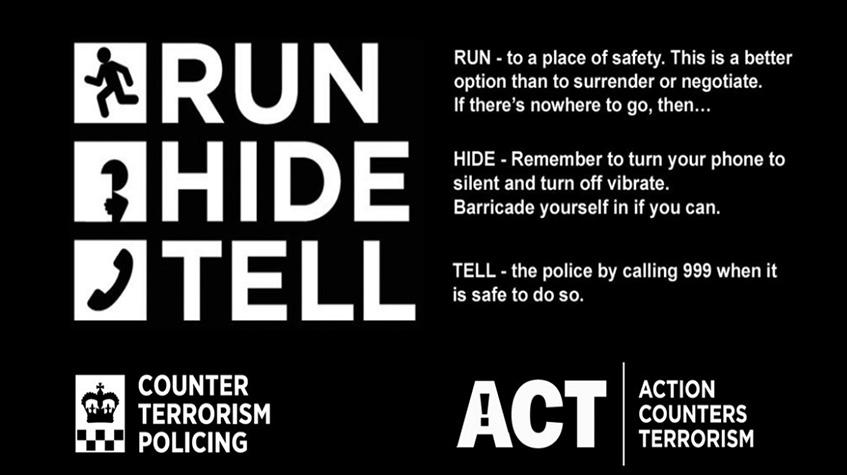
While the overall risk to any individual remains low, it is still important to understand basic response principles. The UK national guidance is simple and easy to remember:
RUN, HIDE, TELL
This is the standard advice used across public safety planning in the UK.
RUN - If it is safe to do so, move away from danger. Do not wait to confirm what is happening. Put distance between yourself and the threat.
HIDE - If you cannot safely leave, find cover. Get out of sight, silence your phone, and avoid drawing attention to your location.
TELL - Once you are safe, call 999 and report what is happening. Provide clear, accurate information if you can.
The focus is always the same: escape if possible, conceal yourself if not, and contact emergency services when safe. This guidance is designed to be simple under stress, not complex.
A Practical Approach to Risk
At UKSN, the focus is not on fear, but on practical awareness. Terrorism is only one of many risks people may encounter in life, and statistically, it is far less likely than everyday incidents like accidents, weather events, or medical emergencies. That is why preparation should be broad, not extreme. It is about building habits and awareness that apply to real life, not just worst-case scenarios.
What Sensible Preparedness Actually Looks Like
You do not need specialist equipment or dramatic measures. Effective preparedness is usually simple:
Being aware of your surroundings when you are in busy places.
Knowing where exits are in buildings you visit.
Having a way to contact family if plans change.
Keeping your phone charged.
Carrying a small amount of cash where possible.
These are small habits, but they improve your ability to respond to any unexpected situation.
Preparedness is not about expecting something to happen. It is about being able to respond if it does.
Keeping Perspective
Headlines often amplify concern, but the reality is more stable. The UK has operated under similar threat levels for many years. Millions of people go about their lives every day without incident. Security systems are designed to reduce risk long before it becomes visible.
Fear does not improve safety. Awareness and clarity do.
The UKSN Mindset
Preparedness is not about reacting to news cycles. It is about building steady confidence through knowledge and simple planning. A move to SEVERE is a reminder to stay aware, not a reason to change how you live.
A Simple Challenge
Take a few minutes today to check your own readiness. Make sure you have an emergency contact clearly saved in your phone. Think about the places you go most often and how you would leave them if needed. Consider how you would reconnect with family if communication networks were disrupted.
In addion to this, download and keep a copy of the UKSN Pocket Emergency Plan, designed as a simple backup when normal communication fails. Also, consider grabbing our I.C.E cards from the store, and if you are a UKSN member, complete our online I.C.E profile.
Small actions like these build real resilience over time, and that matters far more than any headline.


Comments